There was a time when pouring your heart and soul into building enterprise software, shipping reliable cloud architectures, and mentoring team members meant job security. You built things that worked, you hit your delivery milestones, and you helped your team win.
Then the generative AI tsunami hit.
Almost overnight, the narrative changed. Capital expenditures skyrocketed into tens of billions of dollars per quarter for data centers, silicon, and specialized power grids. When boardrooms look at those capital requirements, the budget has to balance somewhere. That “somewhere” has consistently been the people writing the code, architecting solutions, and supporting enterprise customers.
Welcome to “taking one for the team,” corporate style.
The Grand AI Shuffle: Big Tech by the Numbers#
Between 2023 and late 2026, the technology landscape underwent one of the most drastic re-allocations of human resources in modern history. Each of the major players handled the blade differently, but the underlying motivation was identical: satisfy institutional investors, show strict margin discipline, and free up billions to fuel the AI arms race.
| Period | Microsoft (Actions & Estimates) | Google / Alphabet | Amazon (Corporate & Tech) | Meta |
|---|---|---|---|---|
| Jan 2023 | 10,000 (Broad enterprise cut) | 12,000 (Mass company-wide cut) | 18,000 (Corporate, HR, Retail) | 11,000 (Late ‘22 shockwave aftermath) |
| Mid 2023 | 1,000 (Fiscal year-end adjustment) | ~200+ (Recruiting, facilities, News) | 9,000 (AWS, Twitch, Ad systems) | 10,000 (Year of Efficiency cuts) |
| Jan 2024 | 1,900 (Gaming / Core tech realignment) | ~1,000 (Core Eng, Assistant, Devices) | ~500+ (Prime Video, MGM, Twitch) | Continuous hiring freezes in non-AI units |
| Mid 2024 | 1,000 (Azure Cloud & HoloLens cuts) | ~500+ (Core, Python/Flutter, Cloud Partner) | Hundreds (AWS sales, store tech) | Flat staffing, selective attrition |
| May 2025 | 6,000 (Pre-FY end restructuring) | Rolling structural trims | Targeted cuts across Alexa & Devices | Performance-based offboarding |
| Jul - Oct 2025 | 9,000 (FY change-over wave) | ~100+ (Cloud UX, design, managerial layer) | ~14,000 (Manager-flattening drive) | Infrastructure & product consolidations |
| Jan - Apr 2026 | Retirement offer to ~7% of US staff | Rolling department efficiency audits | ~16,000 (Corporate streamlining across AWS) | ~8,000 (Non-AI core teams) |
| Jul 2026 | 4,800 (Sales, services, ops realignment) | Targeted regional trims (WA/CA hubs) | Selective team restructurings | Targeted infra consolidation |
| Oct 2026 | Buyout offer extended to 60,000 | Selective buyouts (Platforms & Devices) | Strict manager-to-IC quota enforcement | Continued shifting of headcount to AI labs |
(Data compiled from corporate announcements, industry trackers, and public disclosures.)
Four Giants, Four Playbooks#
While the spreadsheet results look remarkably similar, each titan rolled out its cuts with a distinctive signature:
- Microsoft: Highly cyclical, aligning deep adjustments to the late spring and summer fiscal year boundaries. Microsoft paired mandatory reduction rounds with voluntary exit programs and retirement incentives to reshape its sales, operations, and legacy platform workforce.
- Google: Ripped off the band-aid with one monumental 12,000-person layoff in January 2023. Since then, Sundar Pichai chose a slow, decentralized burn. Cuts have been distributed as small 100 to 500-person team restructurings that rarely trigger WARN notices, often accompanied by shifting engineering functions offshore.
- Amazon: Andy Jassy swung heavy corporate shears in two large clusters: the 2023 reset (~27,000 roles) and the 2025-2026 management flattenings. Amazon explicitly targeted internal hierarchy, demanding lower manager-to-engineer ratios to squeeze more productivity out of fewer corporate bodies.
- Meta: Coined the “Year of Efficiency” and turned it into an ongoing operating model. Mark Zuckerberg eliminated intermediate management layers, purged duplicate product divisions, and redirected capital almost exclusively toward open frontier model research and server farms.
The Human Toll: Survivor Guilt and the Phantom Promotion#
Behind every cell in that table are mortgages, college funds, healthcare coverage, and careers built on decades of loyalty.
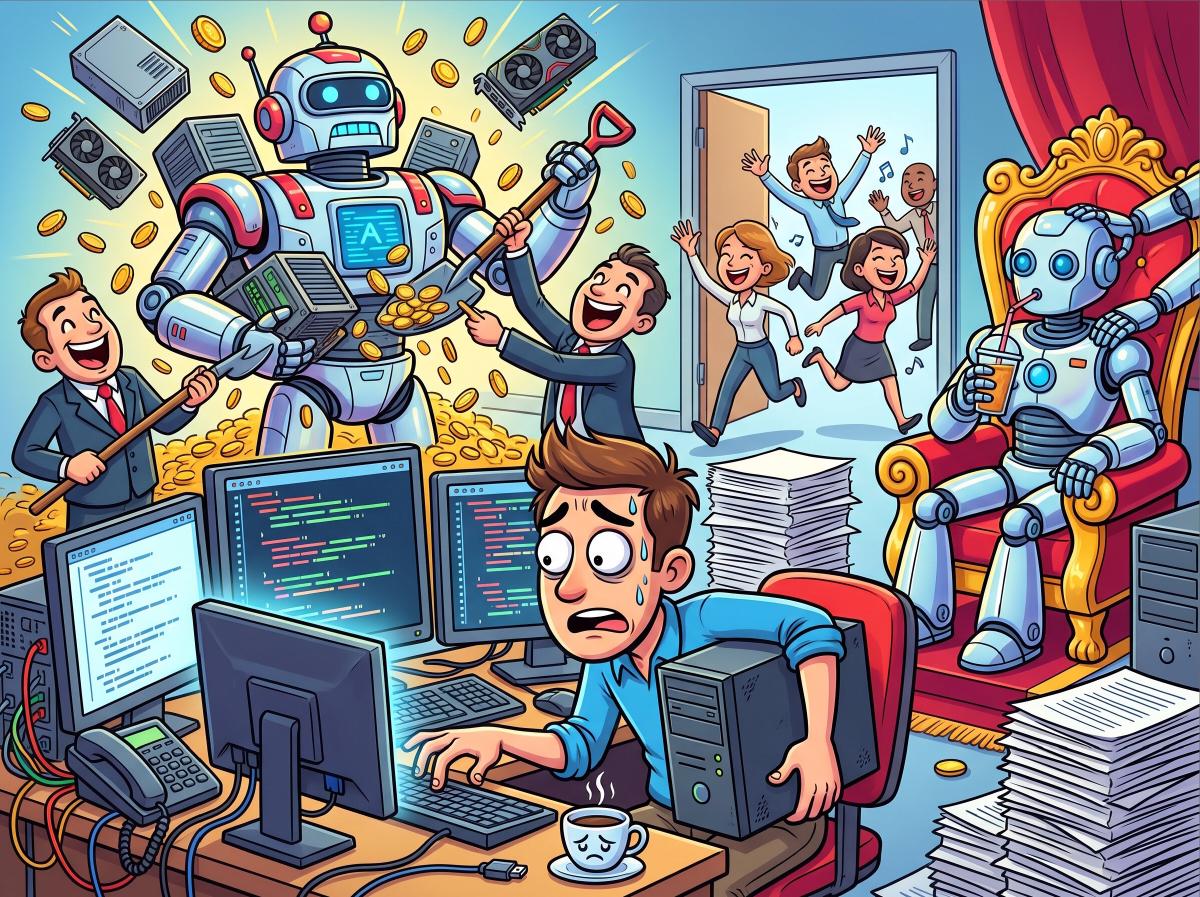
When your coworkers suddenly vanish from Teams or Slack on a Tuesday morning, the emotional fallout is immediate. You feel intense relief that you still have a badge, quickly followed by the gut-wrenching ache of survivor’s guilt. Why did Sarah lose her role when her team delivered on time? Why was an entire engineering pod dissolved when our enterprise customers depend on their codebase every day?
Then comes the real punchline: the remaining work does not disappear.
Instead, the survivors inherit the unfinished backlogs, the legacy support tickets, and the on-call pager rotations. You get handed the responsibilities of two people, occasionally three, all while corporate emails remind you how vital your “agility” is to the mission.
Are salaries doubling? Are bonuses expanding? Hardly. In many cases, merit pools are reduced, equity refreshes face stricter bands, and promotions feel frozen in amber. You are expected to absorb extra cognitive load for identical, or effectively diminished, real compensation once inflation takes its cut. It is a phantom promotion: all of the stress, none of the payoff.
Feeding the Beast#
Let us call this what it is: corporate greed masquerading as technological inevitability.
Big tech companies are printing record quarterly revenues, expanding cloud operating income, and buying back tens of billions of dollars worth of their own stock. Yet leadership points toward AI model training costs and GPU cluster procurement as reasons to tighten corporate belts.
The message sent down the ranks is chillingly simple: your institutional knowledge and years of dedication are variable operating costs. Silicon and kilowatts are fixed investments. When investors reward cuts with stock price surges, the incentive structure ensures that human beings remain the ultimate amortizable asset.
AI will undeniably reshape computing. The models we are building are groundbreaking, and the automation coming down the pipe is astonishing. But if the road to this frontier is paved with burned-out survivors and disposable talent, what kind of culture are we creating on the other side?
Next time leadership talks about sacrifice and dedication for the future, remember who is actually paying the bill.
Trusted Sources & Further Reading#
- The Official Microsoft Blog: Introducing a Voluntary Exit Offer (2026)
- Microsoft 2026 Annual Report & Shareholder Communications
- Microsoft Investor Relations: Quarterly Earnings Disclosures (FY26)
Big Tech Cross-Industry AI Layoff & CapEx Reporting (2026)#
- Investing.com / Reuters: Factbox: Global Companies Cutting Jobs as Investments Shift Toward AI (October 2026)
- Examines corporate workforce downsizings across Microsoft, Amazon AWS/AGI, and Meta as capital flows directly into frontier AI projects and massive data center builds.
- 24/7 Wall St: Tens of Thousands of Tech Workers Laid Off as $725 Billion Replaces Payroll in Compute Race (May 2026)
- Detailed financial breakdown analyzing why Amazon, Microsoft, Alphabet, and Meta are prioritizing CapEx and GPU purchase orders over human payroll.
- Quartz: Major Tech Layoffs in History: Comparative Trends from Amazon and Alphabet to Meta (October 2026)
- Analyzes multi-year reduction waves across Big Tech and how enterprise headcount strategies shifted dramatically between 2023 and 2026.
- The Economic Times: Big Tech Capex vs Free Cash Flow: How AI Budgets Are Squeezing Corporate Headcount (October 2026)
- Covers Meta, Alphabet, and Amazon earnings scrutiny as Wall Street balances surging AI data center investments against operational cost structures.
- The Guardian: Companies Rush in on AI Infrastructure as Workforce Trims Escalate (2026)
- Investigates the human and psychological fallout within major tech engineering hubs as roles are cut to fund high-stakes generative AI bets.
- TechRepublic: Tech Layoffs Analysis and the AI Capital Reallocation (2026)