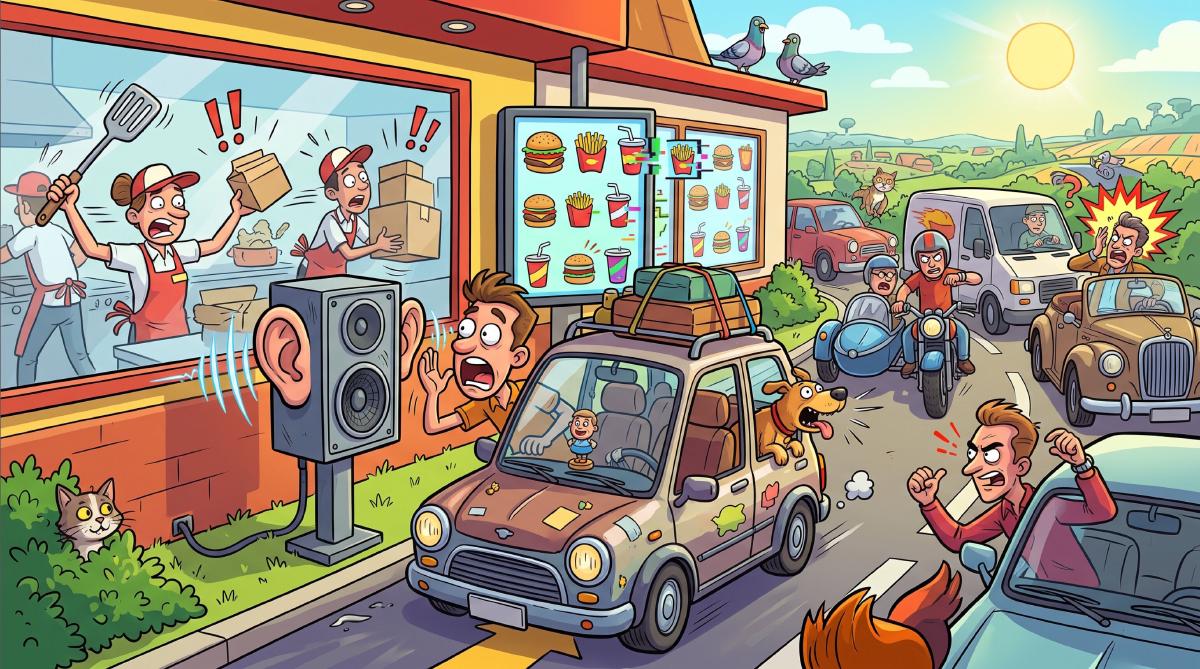
Ever pulled up to a drive-thru speaker box, asked for a breakfast sandwich with no cheese, and held your breath wondering if the system decided you wanted six orders of mozzarella sticks? 🧀 In quick-service restaurants (QSR), nuance is everything.
While enterprise chatbots can afford a relaxed three-second pause while pondering life and generating poetic answers, drive-thru lanes measure performance in milliseconds. A driver idling over a metal induction loop with a diesel truck rumbling next to the intercom speaker box cannot wait around. If inference latency spikes over 1,500ms, customers assume the microphone broke and immediately start shouting “HELLO?!” into the speaker. 🔊
Let us explore what it actually takes to engineer real-time, deterministic voice agents for drive-thru ordering that withstand noisy fryers, barking dogs, and last-minute menu substitutions.
The Reality of the QSR Lane in 2026#
The restaurant industry is balancing operational throughput against intense frontline labor constraints. Industry analyses highlight this balancing act across chains like McDonald’s, Dunkin’, Sonic, and Starbucks:
- Microsoft detailed how autonomous agentic workflows augment retail operations across POS and inventory in their report on Agentic AI Capabilities for Retail Functions.
- The National Restaurant Association highlighted adoption benchmarks in their 2026 Restaurant Operator AI Adoption Report, revealing that while back-office AI adoption has climbed above 25%, customer-facing voice automation demands ultra-high execution accuracy to scale.
- The comprehensive 2026 QSR Drive-Thru Report revealed that drive-thru satisfaction hinges directly on order accuracy, speed perception, and seamless kitchen handoffs.
When voice systems break down, frontline crews endure extra cognitive fatigue rather than getting relief. Designing autonomous voice ordering is not a prompt engineering puzzle. It is an end-to-end distributed systems architecture challenge.
Architectural Challenge: Non-Deterministic Speech vs. Deterministic Point-of-Sale (POS)#
Voice inputs are erratic, messy, and non-deterministic. A Point of Sale (POS) system and Kitchen Display System (KDS), on the other hand, are strictly deterministic finite state machines. If a customer says:
“Can I do a number four combo with a Diet Coke, actually wait make that an iced tea, add extra pickles, drop the onions, and what sauces do you have for the nuggets?”
You cannot feed that unstructured blob into an unconstrained model and hope the POS checkout API parses valid SKUs.
+-----------------------------------------------------------------------------------+
|                            Drive-Thru Audio Loop                                  |
|                                                                                   |
|  [ Customer at Speaker ]                                                          |
|            |  Full-Duplex PCM Audio (WebSockets / gRPC)                           |
|            v                                                                      |
|  [ Edge Audio Gateway & Noise Suppression ] (Filters engine idle, blender whine)  |
|            |                                                                      |
|            +-------------------------------+                                      |
|            |                               |                                      |
|    Fast Classification Stream       Cart Settlement Batch                         |
|            |                               |                                      |
|            v                               v                                      |
|  [ Ultra-Fast Classifier ]       [ Heavy Reasoning Agent ]                        |
|  (e.g., MAI-Code-1.1-Flash /     (e.g., GPT-6.1 Sol / Sonnet 5.5)                 |
|   Haiku 5.5: <300ms Turn Detection)        |                                      |
|            |                               |                                      |
|            +---------------+---------------+                                      |
|                            |                                                      |
|                            v                                                      |
|         [ Stateful Cart Manager & Session Tokens ]                                |
|                            |                                                      |
|               Grounding & Schema Validation                                       |
|                            v                                                      |
|             [ Azure AI Search Vector Index ]                                      |
|             - Local Store Inventory & Modifier Rules                              |
|                            |                                                      |
|            +---------------+---------------+                                      |
|            |                               |                                      |
|            v                               v                                      |
|   [ Outdoor Digital Menu Board ]   [ POS & KDS Integration Engine ]               |
|   (Dynamic Confirmation Display)   (Kitchen Line Ticket & Inventory Ledger)       |
+-----------------------------------------------------------------------------------+
To deliver a reliable drive-thru voice system, three architectural patterns are essential.
1. Dual-Model Routing: Split Intent from Cart Settlement#
Running a massive multi-hundred-billion-parameter reasoning model across every single inbound audio packet destroys your sub-second latency budget.
Instead, split the system into two distinct compute tracks:
- Low-Latency Streaming Edge (Fast Path): Use ultra-fast classification models (such as MAI-Code-1.1-Flash or Haiku 5.5) hooked into full-duplex bi-directional WebSockets. This tier handles Voice Activity Detection (VAD), conversational barge-in, backchanneling (“Got it, one iced tea…”), and intent classification in under 300ms.
- Deterministic Settlement (Cart Path): Route confirmed intents into heavier reasoning engines (such as GPT-6.1 Sol or Sonnet 5.5) running structured JSON schema outputs. This model calculates modifier matrices, validates item combinations, and prepares the cart payload for execution.
2. Menu Grounding with Azure AI Search Vector Retrieval#
Never bake your store menu directly into a system prompt. Drive-thru menus change dynamically based on store-level inventories, breakfast cut-off windows, 86’d ingredients, and regional pricing tiers.
In our open-source reference implementation, we ground natural-language requests against an Azure AI Search vector store indexed with store inventory rules and embeddings:
from azure.search.documents import SearchClient
from azure.search.documents.models import VectorizedQuery
from azure.core.credentials import AzureKeyCredential

async def resolve_menu_item(
    user_utterance: str,
    search_client: SearchClient,
    embedding_service,
    store_id: str
) -> dict:
    # Generate embedding for customer request
    query_vector = await embedding_service.get_embedding(user_utterance)

    vector_query = VectorizedQuery(
        vector=query_vector,
        k_nearest_neighbors=3,
        fields="embedding"
    )

    # Query Azure AI Search with strict store inventory and time filters
    results = search_client.search(
        search_text=None,
        vector_queries=[vector_query],
        filter=f"store_id eq '{store_id}' and is_available eq true",
        select=["item_id", "canonical_name", "price", "allowed_modifiers", "pos_sku"]
    )

    candidates = [doc for doc in results]
    if not candidates:
        return {"status": "out_of_stock_or_invalid"}

    return {"status": "matched", "item": candidates[0]}
Vector matching protects the agent from hallucinating secret menu items while mapping localized slang (“gimme a large pop”) to the exact POS SKU without custom regex dictionaries.
3. Session Tokens and Stateful Order Carts#
A drive-thru order conversation is inherently stateful. You need session tokens that bind the audio stream to the physical lane loop, preventing order collisions between vehicles.
Here is a streamlined pattern from the open-source repository:
import uuid
from pydantic import BaseModel, Field
from typing import List, Dict

class OrderItem(BaseModel):
    item_id: str
    sku: str
    quantity: int
    modifiers: Dict[str, str] = Field(default_factory=dict)
    unit_price: float

class DriveThruOrderCart:
    def __init__(self, lane_id: str, store_id: str):
        self.session_token: str = f"lane_{lane_id}_{uuid.uuid4().hex[:8]}"
        self.store_id: str = store_id
        self.items: List[OrderItem] = []
        self.is_finalized: bool = False

    def add_or_update_item(self, validated_item: OrderItem) -> None:
        if self.is_finalized:
            raise ValueError("Cart is locked for payment processing.")

        # Check for existing item with matching modifier sets
        for existing in self.items:
            if existing.sku == validated_item.sku and existing.modifiers == validated_item.modifiers:
                existing.quantity += validated_item.quantity
                return

        self.items.append(validated_item)

    def calculate_subtotal(self) -> float:
        return sum(item.unit_price * item.quantity for item in self.items)

    def export_pos_payload(self) -> dict:
        return {
            "session_token": self.session_token,
            "store_id": self.store_id,
            "line_items": [item.model_dump() for item in self.items],
            "subtotal": round(self.calculate_subtotal(), 2),
            "status": "READY_FOR_KDS_DISPATCH"
        }
Closing the Loop: Direct KDS and POS Integration#
The final step is dispatching the verified order. Once the speech agent confirms the order at the microphone post, two downstream actions must trigger concurrently:
- Outdoor Digital Menu Board (ODMB) Synchronization: The visual display renders line items in real time so the driver visually validates prices and modifications.
- KDS Dispatch and Inventory Ledger Update: The structured cart payload fires straight into the POS transaction bus, immediately alerting line cooks on the Kitchen Display System screens and decrementing inventory tallies.
Autonomous voice ordering is not about removing crew members from hospitality. It is about removing the friction of manual order entry so restaurant teams can focus on food quality, speed of service, and accurate handoffs at the window. 🍔🍟
Check out the full open-source implementation and architectural reference patterns on GitHub: azureaidrivethru on GitHub.