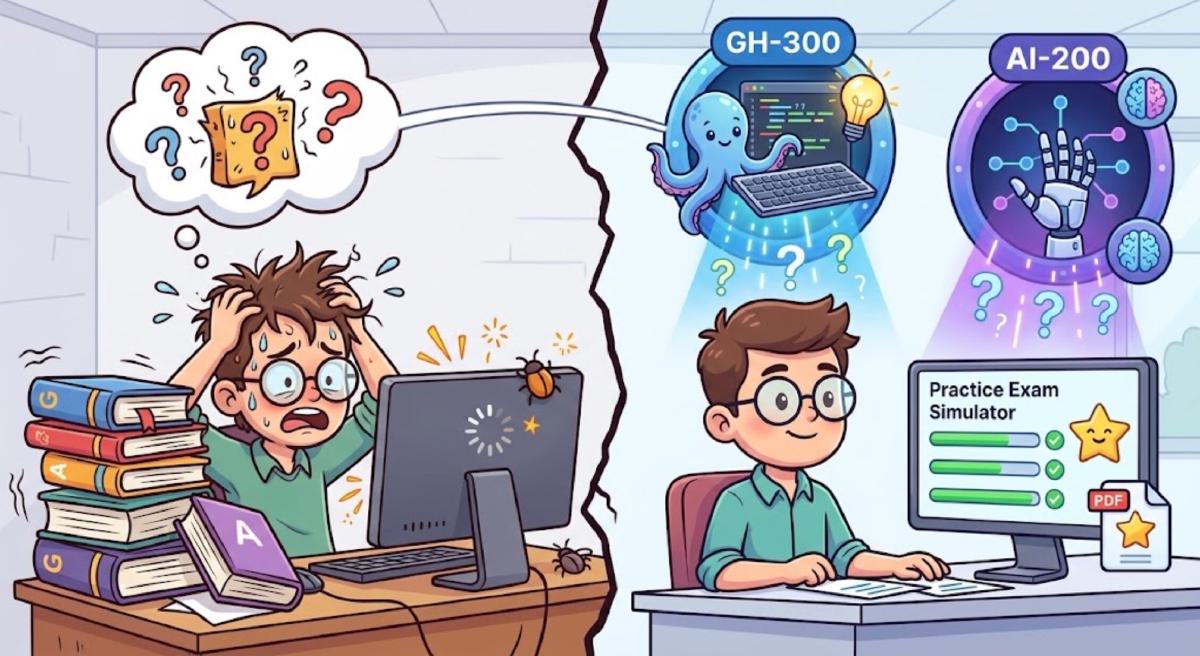
Earning a certification should prove you can do the work, not that you memorized a question dump. When I prepare for an exam, I want three things: practice that behaves like the real exam, an explanation of why each answer is right, and a link to the documentation that backs it up. I could not find all three for two of the exams I care about most right now, so I built them.
There are now two free study hubs on this site, one for GH-300: GitHub Copilot and one for AI-200: Developing AI Cloud Solutions on Azure. Each one includes an exam simulator, hands-on labs, a downloadable PDF of every question, and study material organized around the official skills measured. No sign-up, and nothing you answer is sent anywhere or stored.
Why these two exams belong together#
GH-300 is about using AI to build software. AI-200 is about building the software that runs AI.
GH-300 measures how well you work with GitHub Copilot in your editor, your terminal, and your pull requests, and whether you use it responsibly. AI-200 measures whether you can build the back end an AI application needs in production: the containers it runs in, the databases that store and search its embeddings, the queues and events that connect its services, and the secrets and telemetry that keep it safe and observable.
Plenty of developers now do both jobs in the same week. The two certifications cover both sides of that work.
GH-300: GitHub Copilot#
GH-300 validates that you can use GitHub Copilot productively, responsibly, and securely across the software development lifecycle. The official certification page has registration and the current details.
The exam at a glance#
| Duration | 100 minutes |
| Passing score | 700 out of 1000 |
| Delivery | Online proctored through Pearson VUE |
| Practice assessment | Free and unlimited on Microsoft Learn |
| Renewal | Annually, with a free online assessment |
The six domains#
| Domain | Weight |
|---|---|
| Use GitHub Copilot responsibly | 15–20% |
| Use GitHub Copilot features | 25–30% |
| Understand Copilot data and architecture | 10–15% |
| Apply prompt engineering and context crafting | 10–15% |
| Improve developer productivity | 10–15% |
| Configure privacy, content exclusions, and safeguards | 10–15% |
Two things stand out. Copilot features is the largest domain, and responsible AI is the second largest, ahead of prompt engineering. It is tempting to spend most of your time on prompting, but expect a meaningful share of questions on AI risks and limitations, validating Copilot’s output, and content exclusions.
What is in the GH-300 hub#
- Domain guides for each of the six official domains, with every fact cited to GitHub or Microsoft documentation.
- An exam simulator with 117 questions. Choose 15, 30, 60, or 90 questions or the full bank, turn on an optional 100-minute timer, and get a score on the same 0 to 1000 scale the real exam reports. Miss a question and the review explains why the correct answer is correct and links to the page that says so.
- Eight hands-on labs: Copilot surfaces, a prompt engineering challenge, a full developer workflow, agent mode, enterprise configuration, security-first testing, custom instructions and agents, and an enterprise capstone.
- A printable pocket card for last-minute review, and a 61-page PDF of every question, answer, and explanation.
Start here: GH-300 study hub · GH-300 exam simulator · Official course GH-300T00
AI-200: Developing AI Cloud Solutions on Azure#
AI-200 earns the Microsoft Certified: Azure AI Cloud Developer Associate certification. It is written for developers who build the back-end services of AI solutions, and Microsoft’s audience profile expects you to be comfortable with Python, the Azure SDKs, Azure data services, messaging and eventing, vector databases, containerized applications, and monitoring. The official certification page has registration and the current details.
The exam at a glance#
| Duration | 120 minutes, and the exam may include interactive components |
| Passing score | 700 out of 1000 |
| Level | Intermediate, developer role |
| Practice assessment | Not available yet. Microsoft says these usually appear within about eight weeks of an exam leaving beta |
| Renewal | Annually, with a free online assessment |
The four domains#
| Domain | Weight |
|---|---|
| Develop containerized solutions on Azure | 20–25% |
| Develop AI solutions by using Azure data management services | 25–30% |
| Connect to and consume Azure services | 20–25% |
| Secure, monitor, and troubleshoot Azure solutions | 20–25% |
The data domain is the heaviest, and it spans three different services: Azure Cosmos DB for NoSQL, Azure Database for PostgreSQL with pgvector, and Azure Managed Redis. Expect vector search in all three. Know how each one stores embeddings, how it indexes them, and how to combine similarity search with metadata filters for retrieval-augmented generation (RAG). The containers domain is similarly broad, covering Azure Container Registry and ACR Tasks, containers on App Service, Azure Container Apps with KEDA scaling, and Kubernetes manifests on AKS.
What is in the AI-200 hub#
- Domain pages that quote every objective and skill from the official study guide, show how many simulator questions test each skill, and link the official Microsoft Learn modules that teach it.
- An exam simulator with 109 questions in eight formats, including two case studies. It offers an exam mode and a practice mode, a domain filter, an optional 120-minute timer, and a score for each domain when you finish.
- All 26 hands-on exercises from Microsoft’s official AI-200T00 course, grouped by exam domain so you can practice where you are weakest.
- A 96-page PDF of every question, answer, and explanation, with the case studies printed in full.
Start here: AI-200 study hub · AI-200 exam simulator · AI-200 hands-on exercises
The question formats you will actually see#
Role-based Microsoft exams are not all multiple choice, and the unfamiliar formats cost people time on exam day. The AI-200 simulator reproduces each one so none of them is a surprise.
| Format | What you do | What to watch for |
|---|---|---|
| Multiple choice | Choose one answer. | Read the requirement words, such as minimize cost or least administrative effort. They decide between two plausible answers. |
| Multiple response | Choose the number of answers the question asks for. | Each correct selection is worth one point, so a partly right answer still earns something. |
| Drop-down selection | Pick a value in each row of a table or in each gap of a code segment. | Read the whole code segment before you choose anything. Later lines often decide earlier gaps. |
| Drag and drop | Move answer choices onto the requirement each one satisfies. | A choice may be used once, more than once, or not at all. Do not assume each is used exactly once. |
| Build list | Move the right actions into the answer area and put them in order. | Some actions are distractors, and some questions accept more than one valid order. |
| Yes or No | Decide whether each statement is true, often about code. | Judge every statement on its own. They are independent. |
| Scenario series | The same problem repeats with a different proposed solution each time. | You cannot go back once you move on, so decide each solution on its merits. |
| Case study | Read a company’s environment and requirements, then answer several questions about it. | Skim the requirements first, then return to them for the specific constraint each question hinges on. |
How I would use these hubs to prepare#
- Read the official study guide first. It is the only source guaranteed to be current, and it tells you exactly what is in scope.
- Take a cold baseline. For GH-300, take the free official practice assessment. For either exam, run 30 questions in the simulator with no preparation. The goal is to find your gaps, not to score well.
- Study your weakest domain first. The AI-200 results screen shows your score by domain. The domain pages on both hubs point you to the documentation and official modules for each skill.
- Do the labs. Some of this material only sticks once you have done it: a KEDA scaler that will not trigger, a vector query that burns request units, a Copilot content exclusion that does not behave the way you expected.
- Use practice mode while you learn. On AI-200, practice mode shows the answer and explanation after every question. Save exam mode for checking your progress.
- Finish with full, timed runs. Turn the timer on and take the full bank. Look for scores that are consistently and comfortably above 700, not a single lucky pass.
- Read the explanation for every miss. Follow the link to the documentation. Memorizing that the answer is C helps no one on exam day, when the questions are worded differently and the options appear in a different order.
Fact-checked, and kept current#
Every question, answer, and explanation in both simulators has been checked against current Microsoft Learn and GitHub documentation, and every explanation links to the pages that support it. Product documentation changes, so the hubs change with it. The GH-300 hub tracks the skills measured as of August 7, 2026, and the AI-200 hub follows the study guide dated April 15, 2026. Both simulators draw a fresh, shuffled set of questions on every attempt, so a second run is not the same exam in the same order.
A practice exam is a diagnostic, not a syllabus. Passing one comfortably means you know those questions, which is not the same as knowing the material. Use the simulators to find out where you stand, then close the gaps with the documentation and the labs.
Get started#
Both hubs are free and open to anyone:
- GH-300: GitHub Copilot study hub
- AI-200: Azure AI Cloud Developer study hub
- All study hubs and my certifications
If you use them to prepare, I would love to hear how your exam goes. Good luck!