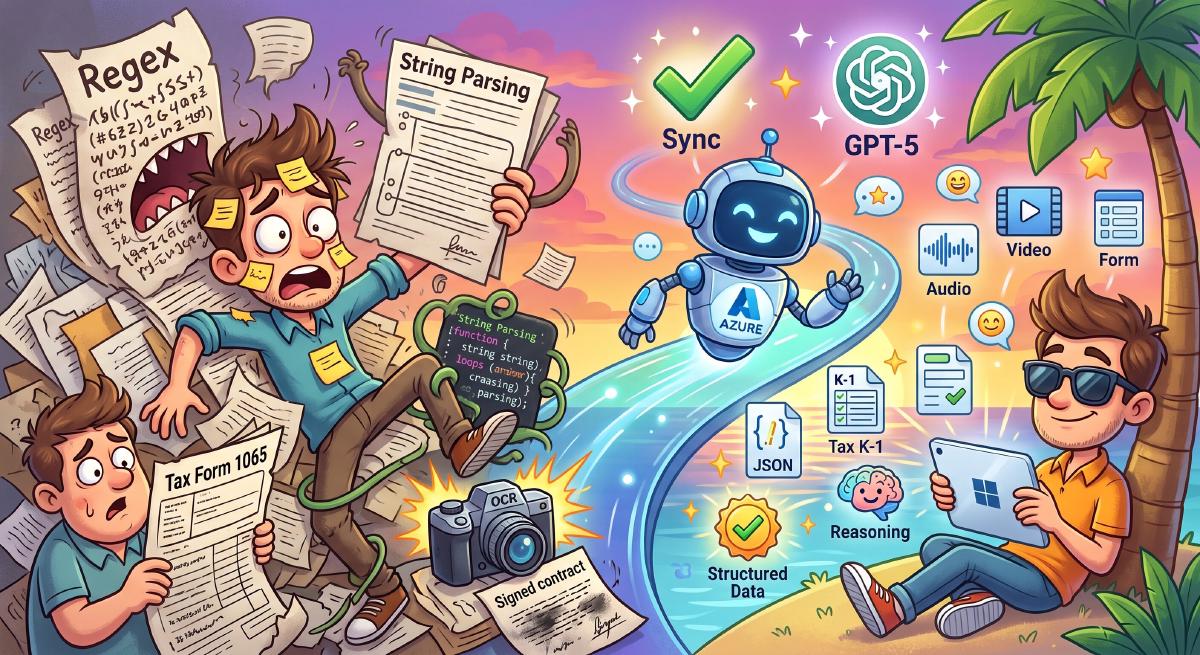

Enterprise data is rarely tidy. The vast majority of valuable organizational knowledge remains trapped inside unstructured PDF packets, scanned tax forms, technical schematics, multi-page legal agreements, and audio/video recordings. For years, document processing meant stitching together optical character recognition (OCR) engines, rigid layout rules, custom regex, and complex post-processing heuristics.
The launch of Azure Content Understanding in Microsoft Foundry fundamentally reshaped this space by combining multi-modal foundation models with structured document extraction pipelines. Today, Microsoft released two major milestones that advance both production efficiency and next-generation agentic capabilities:
- CU 1.0 GA Refresh: A refreshed production API bringing broader GPT-5 model support, up to 28% lower token consumption, and a refreshed confidence scoring model.
- CU 2.0 Public Preview: A preview API introducing low-latency synchronous Read and Layout operations, Advanced Contextualization, semantic chunking, new tax analyzers, and agentic document reasoning.
Here is a deep dive into how Content Understanding has evolved, what these updates bring to enterprise architectures, and how to select the right GPT-5 models for your workloads.
The Evolution of Content Understanding: From Extraction to Reasoning#
To appreciate where Azure Content Understanding is today, it helps to look at the architectural journey of AI-driven document processing:
- Generation 1 (OCR & Rule-Based Forms): Focused strictly on text extraction and fixed key-value pair coordinates. Effective for standardized single-page invoices, but fragile when layouts shifted.
- Generation 2 (Layout & Multi-Modal LLM Extraction): Introduced deep learning models that combined visual layout recognition with LLMs. While powerful, early implementations suffered from high token costs, high latency on large files, and loose grounding.
- Generation 3 (Agentic Content Understanding & Real-Time Sync): Today’s architecture seamlessly blends specialized multi-modal models, structured grounding pipelines, low-latency in-memory APIs, and multi-pass agentic reasoning. Content is no longer just “extracted”; it is reasoned over, contextualized, and fed directly into real-time decision-making systems and autonomous AI agents.
CU 1.0 GA Refresh: Better Economics and Reliability for Production#
For enterprise architectures running production workloads, the refreshed CU 1.0 API (version 2025-11-01) directly addresses three core operational priorities: model versatility, token cost, and routing confidence.
1. Broader GPT-5 Model Series Integration#
Content Understanding analyzers can now leverage the entire GPT-5 family, including GPT-5.5, GPT-5.4, GPT-5.3, GPT-5.2, GPT-5.1, as well as Mini and Nano variants. This allows development teams to fine-tune the tradeoff between model latency, extraction accuracy, and compute unit consumption on an analyzer-by-analyzer basis.
2. Improved Grounding Efficiency (Lower Token Consumption)#
By merging data extraction and source-grounding into a unified processing pass, the refreshed GA API reduces average inference token usage by up to 28% for GPT-4.1 and GPT-5.2 models, while boosting extraction accuracy by up to 3%. For high-volume enterprise ingestion pipelines, a 28% reduction in token consumption significantly lowers overall operating costs while preserving exact source traceability.
3. Refreshed Confidence Scoring#
Automated pipelines rely on confidence scores to determine whether a document can be processed straight through or requires routing to human-in-the-loop validation. The refreshed confidence scoring model improves accuracy (measured by AUROC) by up to 14%. Stronger confidence calibration allows architects to safely raise automation thresholds without increasing risk.
CU 2.0 Public Preview: Next-Generation Building Blocks for AI Agents#
While CU 1.0 focuses on optimizing existing production workloads, the new CU 2.0 Public Preview (2026-06-01-preview) unlocks entirely new architectural patterns.
Low-Latency Synchronous Operations#
Traditionally, document analysis pipelines ran asynchronously via job queuing. However, real-time agentic workflows (such as grounding a customer service agent during a live session or validating identity documents during onboarding) require instantaneous responses.
As detailed in the Azure Content Understanding Synchronous Operations Announcement, CU 2.0 introduces inline synchronous operations for Read (prebuilt-read) and Layout (prebuilt-layout) analyzers:
- In-Memory Processing: Processes binary data or document URLs without temporary service-side storage, fulfilling strict confidentiality and compliance mandates.
- Low Latency: Returns structured JSON payloads directly in the HTTP response body for payloads up to 10 MB, 5 pages, or 30,000 characters.
Advanced Contextualization & Prebuilt Tax Analyzers#
Advanced Contextualization alters how training examples and domain knowledge are passed to custom analyzers. Customer training data remains securely inside the user’s Azure Storage account and acts as a contextual knowledge layer rather than being copied.
In new prebuilt tax analyzers (supporting complex schedules such as Form 1065, 1120-S, 8865, 1041 Schedule K-1, and Minnesota State M1), Advanced Contextualization slashes LLM token consumption by up to 99%, with certain extraction fields requiring zero additional LLM tokens.
Semantic Chunking for RAG & Agentic Retrieval#
Standard fixed-length chunking often truncates tables, severs headings from parent paragraphs, or breaks visual relationship context. In prebuilt-documentSearch, semantic chunking evaluates physical document structure to form cohesive, contextually complete units. This dramatically improves retrieval accuracy in Retrieval-Augmented Generation (RAG) pipelines.
Agentic Mode for Complex Document Reasoning#
Standard single-pass extraction often fails when dealing with multi-page commercial contracts, insurance claim packets, or intricate financial filings where evidence is distributed across disparate sections.
CU 2.0 introduces Agentic Mode, an iterative extraction workflow. The model conducts multiple reasoning passes over the schema, evaluating intermediate extraction results, cross-referencing conflicting sections, and refining output fields before returning a final grounded response.
Model Selection Strategy: Quality, Latency, and Cost#
Choosing the right foundation model behind your analyzer is akin to mixing audio on a soundboard: you are balancing extraction quality against latency and token budget.
Based on benchmark testing from the Azure Content Understanding GPT-5 Series Guide, here are key model selection recommendations across modalities:
| Modality | Balanced Recommendation | Best Quality Choice | Lower-Cost Choice |
|---|---|---|---|
| Document | GPT-5.1 or GPT-5.2 | GPT-5.5 (+2% quality at ~101% higher cost) | GPT-5.4 Mini (~50% cost savings with -2% quality) |
| Speech | GPT-5.1 or GPT-5.2 | GPT-5.5 (+2% quality at ~101% higher cost) | GPT-5.4 Mini (~48% cost savings with -2% quality) |
| Video | GPT-5 or GPT-5.1 | GPT-5 or GPT-5.1 (Equal top performance) | GPT-5 Mini (~28% cost savings with -7% Generation F1) |
| Image (Classify) | GPT-5.1 | GPT-5.1 (Top classification F1) | GPT-5 Mini (~52% cost savings with -12% Classify F1) |
| Image (Generate) | GPT-5 Mini | GPT-5.5 (+3% quality at ~375% higher cost) | GPT-5 Mini |
Roadmap Futures and Architectural Next Steps#
As enterprise AI shifts from passive knowledge retrieval to active agentic execution, Azure Content Understanding provides the foundational bridge between unstructured raw files and structured, grounded intelligence.
To start evaluating these updates in your own solution architecture:
- Explore Content Understanding Studio: Test candidate models side-by-side using representative document samples.
- Evaluate Request-Level Overrides: Swap candidate models dynamically in your REST or SDK calls using the
modelDeploymentsmapping to measure accuracy versus token usage in real time. - Adopt Synchronous APIs for Low-Latency Workloads: Refactor identity check and agentic chat pipelines to utilize real-time inline Read and Layout operations.
By pairing the cost efficiency of the refreshed CU 1.0 GA API with the agentic capabilities of CU 2.0 Preview, solution engineers can build document processing pipelines that are not only faster and cheaper, but significantly smarter.