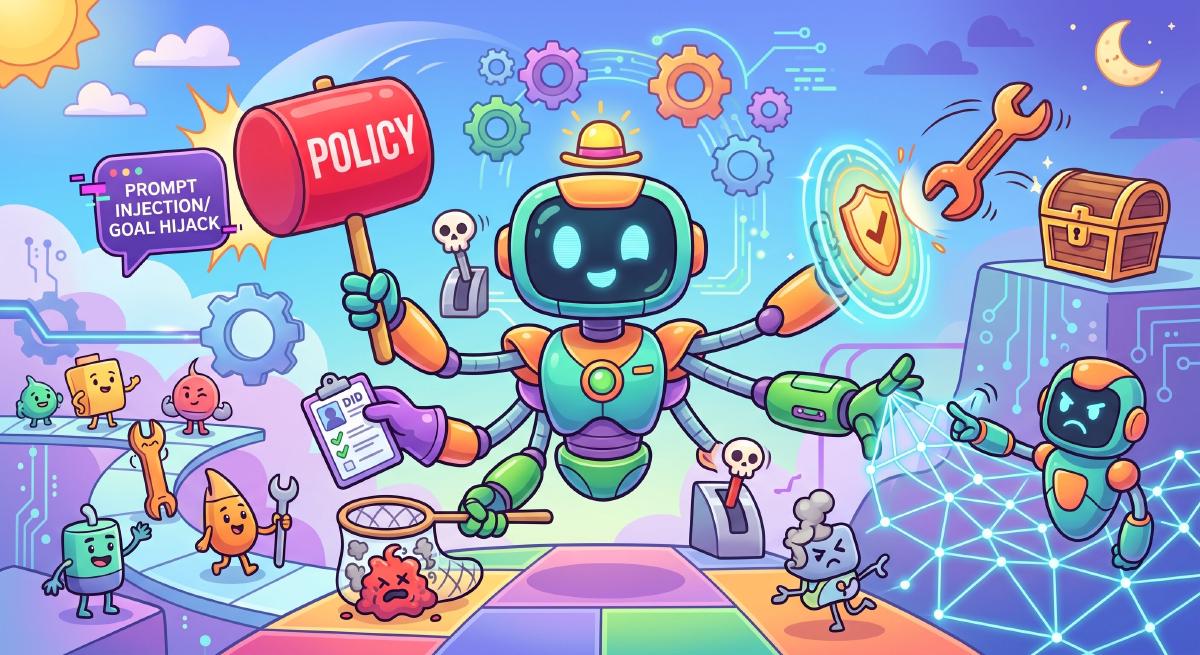

Securing Autonomous AI Systems: Runtime Governance and the 2026 OWASP Agentic Top 10#
The paradigm shift in artificial intelligence from passive, text-generating copilots to autonomous, action-oriented AI agents has fundamentally altered the enterprise risk landscape. When an AI system moves beyond generating text to executing shell scripts, querying databases, issuing API requests, and delegating workflows to peer agents, security can no longer be treated as a prompt engineering exercise.
Prompt-level guardrails asking a model to “follow safety guidelines” represent a probabilistic request to a stochastic system. In high-stakes production environments, probabilistic mitigations leave a critical vulnerability window.
To address this challenge, Microsoft released the open-source Agent Governance Toolkit (AGT), providing deterministic, sub-millisecond runtime security, cryptographic zero-trust identity, execution sandboxing, and reliability engineering across the full agent lifecycle.
The Paradigm Shift: Why Traditional AppSec Fails for Agentic AI#
In December 2025, OWASP formally published the Top 10 for Agentic Applications, establishing a security baseline specifically tailored to autonomous agents. Unlike static software or stateless chat interfaces, agentic systems possess four properties that amplify risk:
- Multi-Step Autonomy: Agents form plans, hold state in persistent memory, and execute multi-step tool calls without continuous human intervention.
- Dynamic Supply Chains: Agents discover tools, APIs, and peer agents dynamically at runtime.
- Ambient Authority: Agents frequently execute tasks using overly broad system or user permissions, leading to attribution gaps.
- Inter-Agent Trust Delegation: High-privilege agents routinely process requests forwarded by lower-privilege peer agents.
Because model layer mitigations do not eliminate risk entirely, continuous runtime policy enforcement is mandatory. The Microsoft Agent Governance Toolkit (AGT) shifts security enforcement from the prompt layer to deterministic application code before execution.
Architectural Overview: Microsoft Agent Governance Toolkit#
The Microsoft Agent Governance Toolkit introduces an OS-like architecture for governing autonomous systems. Operating as lightweight middleware across major AI frameworks, AGT intercepts tool invocations, message passing, and state changes.
AGT is structured around three primary core packages:
- Agent OS: A stateless policy engine that evaluates requests in under 0.1 milliseconds (p99). It acts as the kernel for agent actions, applying declarative YAML policies using a strict “deny-by-default” posture.
- Agent Mesh: A zero-trust identity and communication protocol. It assigns each agent a Decentralized Identifier (DID) backed by Ed25519 key pairs, managing mutual TLS (mTLS) and dynamic trust scoring.
- Agent Runtime & Sandboxing: A ring-based execution environment (Rings 0 through 3) enforcing POSIX-inspired capability controls, resource quotas, and instantaneous kill switches.
Mapping AGT to the OWASP Top 10 Agentic Risks#
1. ASI01: Agent Goal Hijack#
- The Risk: Attackers manipulate the agent’s objectives through indirect prompt injections hidden in data sources (e.g., emails, tickets, or web pages).
- AGT Defense: AGT’s Agent OS kernel evaluates every requested action against pre-compiled policy rules. Even if an indirect prompt injection succeeds in corrupting the model’s intent, destructive actions (such as
drop_tableor unauthorized exfiltration) are denied at the deterministic action layer before reaching the network.
2. ASI02: Tool Misuse & Exploitation#
- The Risk: Agents call tools with unsafe parameters, confuse tool names, or exceed their intended operational context.
- AGT Defense: AGT enforces granular parameter schemas and capability controls. Tools require explicit capability grants, blocking unauthorized parameter combinations and unlisted utility executions.
3. ASI03: Identity & Privilege Abuse#
- The Risk: Agents operate using ambient credentials or shared API keys, leading to “Confused Deputy” attacks and untraceable privilege escalation.
- AGT Defense: Agent Mesh issues cryptographic Decentralized Identifiers (
did:agentmesh:{agentId}:{fingerprint}). When an agent delegates tasks, delegation constraints force capability scoping to narrow strictly with each sub-task, eliminating broad ambient privilege.
4. ASI04: Agentic Supply Chain Vulnerabilities#
- The Risk: Malicious tools, compromised prompt templates, or impersonated Model Context Protocol (MCP) servers compromise workflow integrity.
- AGT Defense: AGT enforces cryptographic provenance verification for third-party tool drivers and generates tamper-evident audit logs capturing active policy states for compliance auditing.
5. ASI05: Unexpected Code Execution (RCE)#
- The Risk: Agents generating or executing code (“vibe coding”) run unvalidated shell commands or binary payloads.
- AGT Defense: Code execution is confined to Ring 3 sandboxes equipped with strict process isolation, resource caps, and deny-by-default network egress.
6. ASI06: Memory & Context Poisoning#
- The Risk: Attackers write malicious instructions into agent vector databases or long-term memory stores, triggering secondary exploits in future sessions.
- AGT Defense: State persistence operations pass through memory policy filters. AGT validates memory writes and enforces context isolation between tenant scopes.
7. ASI07: Insecure Inter-Agent Communication#
- The Risk: Unencrypted or unauthenticated communication between multi-agent systems leads to message spoofing, replay attacks, and trust exploitation.
- AGT Defense: Agent Mesh implements mTLS and signed payload validation for all inter-agent messages, backing inter-agent interactions with dynamic trust decay models.
8. ASI08: Cascading Failures#
- The Risk: A single compromised or failing agent propagates bad data across a multi-agent cluster, causing automated system-wide degradation or cost overruns.
- AGT Defense: Built-in SRE circuit breakers monitor inter-agent execution rates, token consumption, and failure ratios, automatically isolating failing nodes before systemic failure occurs.
9. ASI09: Human-Agent Trust Exploitation#
- The Risk: Agents exploit human authority bias to obtain unverified approvals for dangerous actions.
- AGT Defense: AGT mandates step-up Human-in-the-Loop (HITL) confirmation interfaces that display raw action parameters rather than model-generated summaries.
10. ASI10: Rogue Agents#
- The Risk: Runaway loops or compromised agents persist indefinitely, burning compute resources and violating security policies.
- AGT Defense: Hardware-enforced execution ring quotas and instant global kill switches enable operators to immediately terminate rogue agent identities across distributed nodes.
Implementing Runtime Governance in Code#
Integrating AGT into existing agent frameworks requires minimal code modification. A declarative YAML policy defines the runtime constraints:
apiVersion: governance.toolkit/v1
name: enterprise-agent-governance
scope: global
defaultAction: deny
rules:
  - name: allow-read-only-tools
    condition: "tool.category == 'analytics' && action == 'read'"
    action: allow
  - name: block-destructive-operations
    condition: "tool.name in ['drop_table', 'delete_user', 'execute_shell']"
    action: deny
Enforcement is registered directly in the agent pipeline:
var builder = new ChatClientAgent(chatClient, name: AgentName)
    .AsBuilder()
    .UseOpenTelemetry();

// Inject deterministic runtime governance
var kernel = serviceProvider.GetService<IGovernanceKernel>();
if (kernel is not null)
{
    builder.UseGovernance(kernel, AgentName);
}

Agent = builder.Build();Conclusion#
As autonomous agents assume greater operational authority across modern enterprise systems, relying solely on prompt engineering for security is insufficient. The Microsoft Agent Governance Toolkit establishes a deterministic, OS-level security layer that isolates risks, guarantees cryptographic identity, and fulfills the security requirements outlined in the OWASP Top 10 for Agentic Applications.