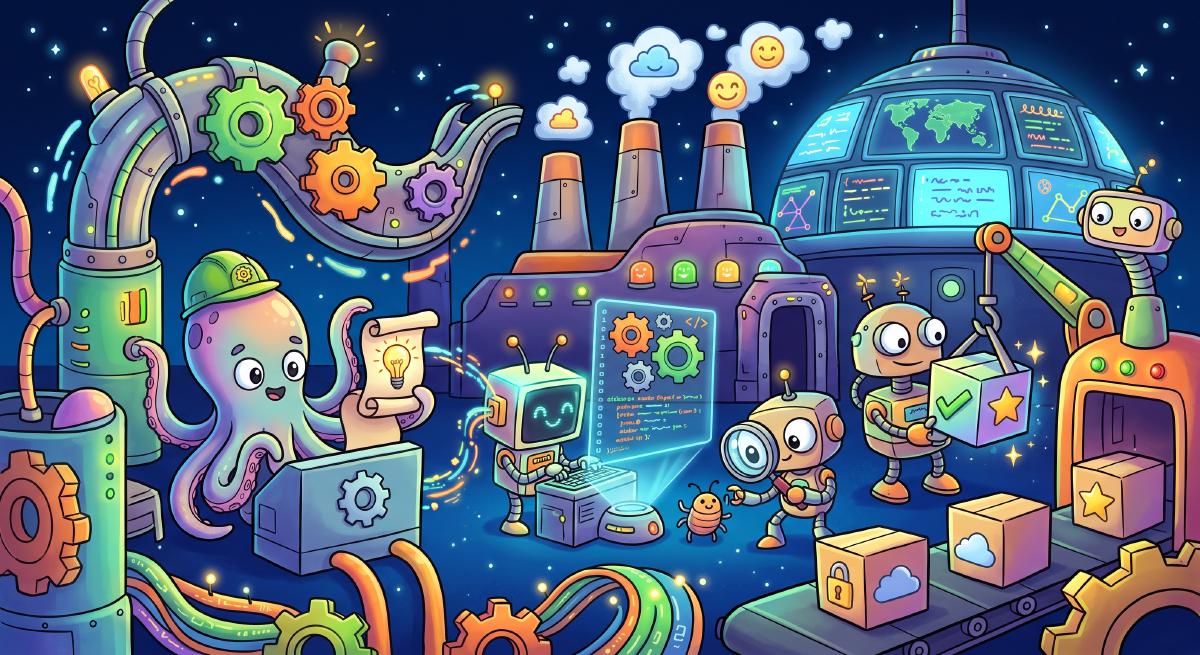

The concept of the “dark factory” originated in physical manufacturing: fully automated facilities operating without human presence, running around the clock in the pitch black because machines do not need light to assemble cars or forge steel.
For decades, software development was assumed to be immune to this level of automation. Writing software required nuanced human reasoning, contextual understanding, iterative debugging, and creative architectural design. However, with the rapid emergence of agentic AI frameworks and specialized developer tooling, we are standing on the threshold of the Software Dark Factory.
What Is a Software Dark Factory?#
In a software dark factory, human engineers no longer write lines of code line-by-line, configure endless CI/CD pipelines by hand, or manually verify edge-case test suites. Instead, developers move up the abstraction ladder to act as System Architects and Intent Designers.
To learn more about the broader architectural shift behind autonomous software delivery, check out this guide on Dark Software Factories and Autonomous Delivery.
In this paradigm, the developer inputs high-level intent:
“Add multi-tenant billing support using Stripe APIs, ensuring all database schema migrations pass existing compliance rules and load tests.”
From that single declaration of intent, autonomous AI agent teams take over:
- Requirements & Architecture Phase: Agents parse existing codebases, review security policies, and propose structural changes.
- Implementation Phase: Sub-agents branch the repo, write clean code across frontend and backend services, and integrate third-party APIs using standardization protocols like the Model Context Protocol (MCP).
- Verification & Testing Phase: Testing agents spin up ephemeral environments, run unit, integration, and security regression suites, and continuously self-heal code errors until every check passes.
- Deployment & Release Phase: Automated reviewer agents summarize the pull request, perform safety audits, and merge the final deployment to production.
All of this happens autonomously, overnight, in a virtual “dark factory.” For a deeper dive into the levels of agentic autonomy and lights-out codebases, read this breakdown on What Is a Dark Factory Codebase?.
Exploring GitHub Agentic Workflows (gh-aw)#
A major step toward this vision is the GitHub Agentic Workflows Workshop, developed by GitHub Next.
Traditionally, GitHub Actions rely on deterministic, step-by-step shell scripts. If an unexpected runtime error occurs, the pipeline fails and awaits human intervention. Agentic workflows replace rigid scripts with non-deterministic, goal-seeking AI agents embedded directly inside event-driven GitHub repositories.
Key technical pillars enabling this shift include:
- Intent Briefs over Shell Scripts: Workflows are defined using markdown task briefs that describe what the agent should accomplish rather than hardcoded commands.
- Model Context Protocol (MCP) Integration: Agents receive secure, scoped access to external tools, API servers, database connections, and specialized diagnostic engines.
- Inline Sub-Agents & Decomposition: Complex tasks are split across specialized sub-agents (e.g., an architectural planning agent, a coding agent, and a security auditing agent).
- Persistent & Repository Memory: Agents maintain state across execution runs, allowing them to learn repo patterns and track long-running issues over time.
- Sandboxed Security & Safe Outputs: Strict permission boundary models prevent prompt injection, privilege escalation, and repository poisoning.
From Copilot to Autonomous Collaborator#
We are witnessing a fundamental transition in developer tools:
[ Inline Autocomplete ] –> [ Chat & PR Review ] –> [ Autonomous Agentic Workflows ]
(Copilot 1.0) (Copilot Workspace) (Software Dark Factory)
- Copilot as Assistant: Suggesting the next line or block of code as you type.
- Copilot as Pair Programmer: Answering codebase questions, generating PR descriptions, and drafting test files on command.
- Copilot as Autonomous Agent: Receives an issue or feature ticket, spins up isolated execution environments, builds and executes tests, and delivers fully functional software without intervention.
The Road Ahead: Deterministic Safety + Non-Deterministic Reasoning#
The key challenge in building autonomous software factories isn’t getting AI to write code; it’s ensuring reliability, security, and predictability.
Combining deterministic infrastructure (like GitHub Actions runners, automated test runners, and static analysis security tools) with non-deterministic AI agents creates a self-correcting feedback loop. If an agent writes code that breaks a build, the build failure output feeds directly back into the agent context, prompting it to fix its own bug before any human sees the pull request.
As agentic tools like gh-aw mature, the role of the developer transforms into setting vision, establishing guardrails, and curating architectural patterns. The software dark factory isn’t about replacing software engineers; it is about freeing engineers from toil so they can focus on high-impact innovation.