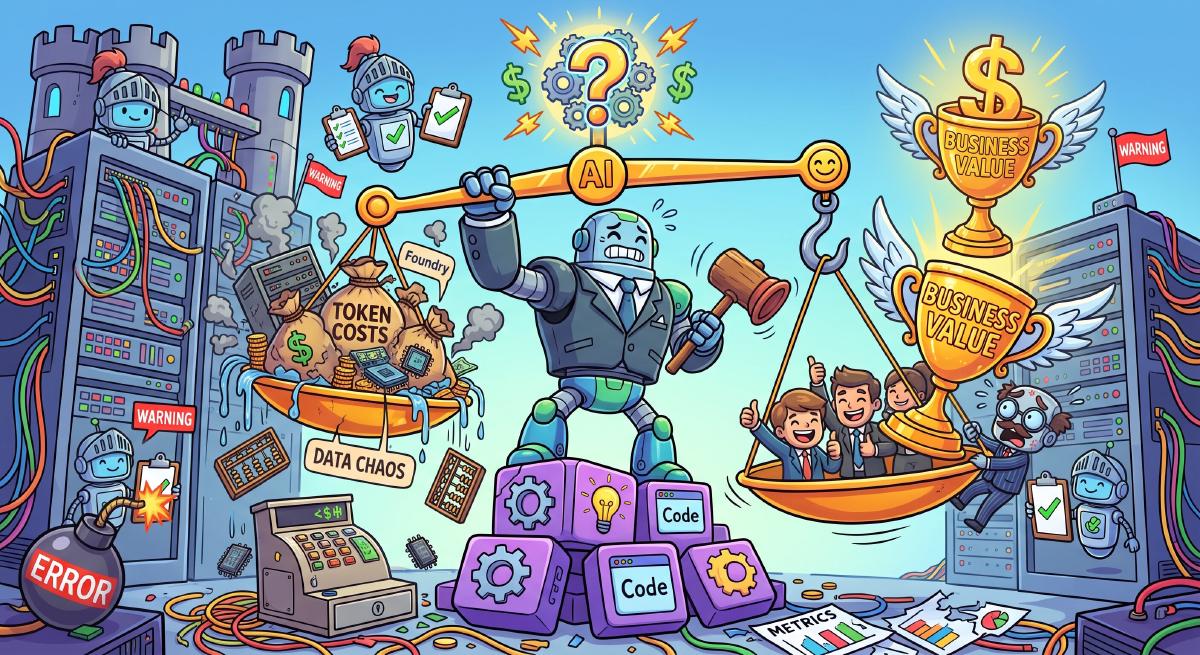

Building a proof-of-concept AI agent has never been easier. With a few lines of code and the right orchestration framework, you can have an agent summarizing text, querying databases, or handling basic customer triage in an afternoon.
But moving that agent into enterprise production is entirely different. For too long, organizations have measured AI success using purely technical metrics. We look at prompt tokens, completion tokens, latency, and model accuracy scores. While these are critical for engineers, they don’t mean much to the business leaders funding the project. Your CFO doesn’t care about your vector database’s latency; they care about the bottom line.
If a claims processing agent runs perfectly from a technical standpoint but costs more in model calls and tool execution than the manual process it replaced, it is a business failure. The era of deploying AI just for the sake of innovation is wrapping up. To secure ongoing funding, enterprise AI must focus squarely on tangible business outcomes.
The Shift to Outcome-Based AI#
Proving a return on investment has become the defining challenge for enterprise tech leaders. This trend is heavily documented across recent industry insights:
- Comprehensive research by Microsoft and LinkedIn (The Work Trend Index Special Report) confirms that 71% of leaders say they would rather hire a less experienced candidate with AI skills than a more experienced candidate without them. The primary driver is no longer experimentation; it is quantifiable productivity gains, with 90% of current users reporting that Copilot helps them get core tasks done faster.
- Industry updates from Redmond Magazine underscore that tech giants are collectively putting billions behind aggressive enterprise deployment pushes, making defensible financial reporting an absolute necessity for internal teams.
The message is clear: AI must move from a cost center to a value generator.
Enter Azure AI Foundry: ROI for Agents#
To bridge the gap between developer metrics and business impact, Microsoft introduced ROI for Agents in Foundry. Announced in private preview, this feature allows engineering and business teams to co-author a financial truth for their AI systems.
The system operates on a straightforward foundational formula:
ROI = (Business Value Gained — Total Cost) / Total Cost
Instead of guessing, the platform leverages your live Application Insights trace data to combine conversation context, token counts, and tool execution costs into a unified view.
[Connect Traces] ➔ [Select Business Evaluator] ➔ [Map to Financial Value] ➔ [Monitor Dashboard]
The magic happens when you pair your telemetry with a Business-Value Evaluator. You can map successful, custom-defined outcomes (like a support ticket successfully deflected or a lead qualified) directly to an assumed dollar value. If an agent iteration begins running negative ROI, developers can instantly drill down into the traces to figure out if an expensive model version or an inefficient tool loop is burning cash.
Key Learnings from Build 2026 (Session BRK252)#
This capability was a major highlight at Microsoft Build 2026 during session BRK252: From observability to ROI for AI agents on any framework.
The session drove home a vital point for modern architects: your telemetry must be framework-agnostic. Whether you are building native agents inside Azure or using external frameworks, the Agent DevOps lifecycle demands a closed-loop system. You must be able to trace every step, run intelligent evaluations, optimize behavior, and explicitly prove the final financial value on a single control plane.
Building a Defensible AI Strategy#
If you want your agent architectures to survive the next budget review, stop reporting on how many thousands of tokens your app processed last month. Start building your data models around operational efficiency, customer satisfaction improvement, and direct cost reduction. Tools like Azure AI Foundry are finally giving us the plumbing to make that translation seamless.
To explore further perspectives on enterprise AI value and strategies, check out these recent resources:
- Read the announcement details on the Microsoft Azure AI Foundry Blog.
- Dive into full lifecycle optimization strategies via the Microsoft Build BRK252 Session Overview.
- Analyze empirical ROI data in the Microsoft Work Trend Index Special Report.