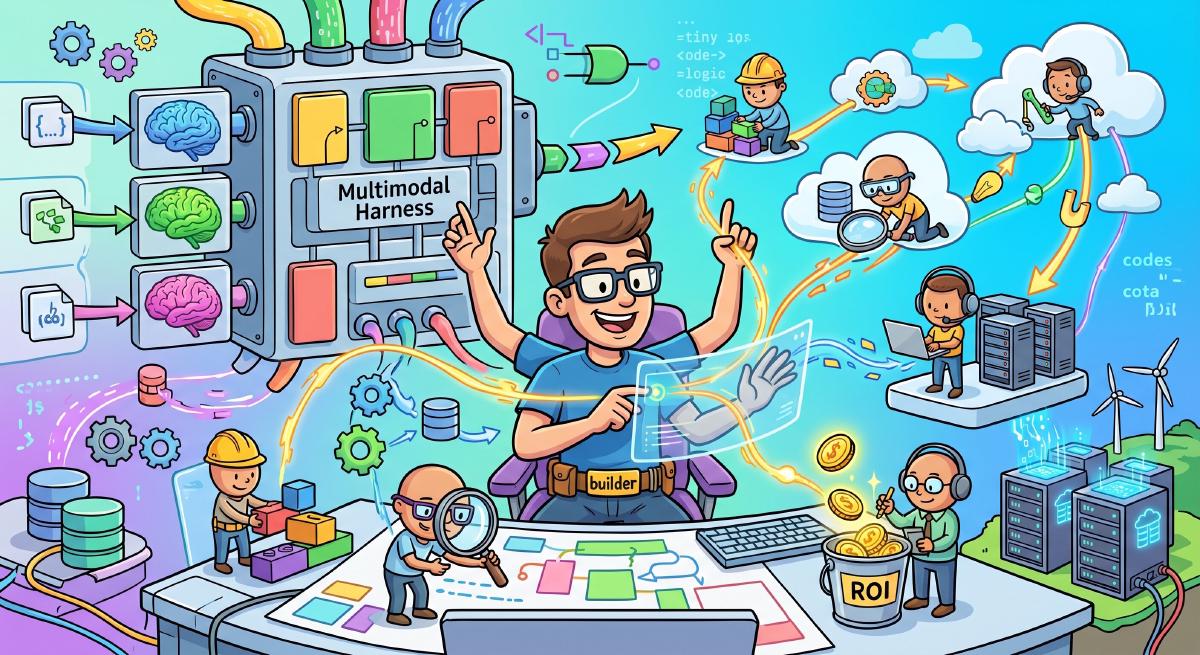

The architectural paradigm of artificial intelligence has officially broken past the bounds of single-model prompt engineering. At a recent crossover panel, Microsoft Chairman and CEO Satya Nadella articulated a structural shift that maps directly onto the challenges enterprise architects face today: the evolution from standard foundational models to multi-model harnesses that coordinate deterministic workflows with cognitive cores.
For engineering leaders navigating this frontier, the transformation demands a re-evaluation of data gravity, system orchestration, and the changing definition of intellectual property.
1. The Multi-Model Harness vs. The Altar of One Model#
A primary takeaway from Satya’s perspective is a clear warning against platform mono-culture:
“A platform is defined by fundamentally its ability to create more value about the platform versus what’s captured in the platform… Otherwise, why have a developer conference? I can just come and have you all sort of just worship at the altar of one model. But that’s not a developer conference.”
In practice, this means enterprise systems should not lock their architecture into a single model’s API. Instead, developers are implementing multimodal harnesses—scaffolding frameworks that abstract the core orchestration layer away from the underlying model. This pattern decouples execution strategy from model pricing and fluctuating token windows.
The Anatomy of an Enterprise Harness#
An enterprise-grade agentic harness coordinates three interconnected pillars:
- The Models: Dynamically routing tasks between frontier reasoning models (such as GPT-5-class systems for complex planning) and smaller, specialized local or open-weights models (like 5-billion parameter reasoning cores) for execution and classification.
- The Data & Context Layer: Compressing massive enterprise datasets into high-fidelity, temporal contexts. The system must prep the context layer so the agent can execute code or make decisions without generating massive token waste.
- The Tools: Providing progressive tool disclosure, enabling long-running agents to interact with localized CLI utilities, database schemas, and external microservices under strict, delegated authority.
2. Private Evals: The Modern Enterprise Intellectual Property#
One of the most profound architectural insights shared is the transition of enterprise value from raw training data or historical experience to private evaluation structures (evals) and execution traces.
As foundational models become democratized and commoditized, a company’s unique terminal value resides in its ability to verify correctness inside its specific domain. Satya emphasizes:
“Each company will have its own private eval… Bounding your system with a private eval that you can use a frontier model to hill climb on and not leak the traces may be one of the biggest drivers of IP.”
Compounding Tacit Knowledge#
Historically, human capital and tacit organizational knowledge could not sit on an enterprise balance sheet. In an agentic framework, every interaction between an engineering team, a multi-agent orchestration session, and production telemetry creates an execution trace.
By analyzing these traces within a private eval loop, organizations can continuously optimize their agents, moving from an un-tuned generalist model to a “company veteran agent.” The key architectural litmus test for platform independence is interoperability: If you swap the underlying foundational model from Provider A to Provider B, does your private eval score continue to hill-climb? If yes, your system architecture is decoupled and defensible.
3. Real-World Engineering Tooling: From Squad to Claude Code#
The paradigm shift isn’t theoretical; it is actively reshaping developer tooling and multi-agent frameworks. When building agentic systems, architects are turning to frameworks that enable coordinated multi-agent runtime environments.
- Brady Gaster’s Squad Framework: A prime example of multi-agent orchestration within modern ecosystems. Frameworks like Squad establish standard communication channels, state tracking, and shared memory layers across multiple concurrently executing agents. This allows for complex workflows where an orchestration agent can spin up a dedicated coding agent, a separate testing/QA agent, and an evaluation agent to validate results before presenting the final code to a human developer.
- Claude Code & Agentic CLIs: Tools like Claude Code represent the rapid compression of developer workflows. Instead of interacting through simple chat interfaces, these tools operate natively inside file systems and repositories, executing multi-step diagnostic, refactoring, and code generation routines over extended periods.
Rebuilding the IDE Canvas#
This shift introduces a new friction point: cognitive load transfer. When an engineer runs a session that coordinates a hundred agent threads simultaneously, traditional line-by-line or terminal-only IDE interfaces fall apart.
The industry is rapidly shifting toward a canvas-based UI model. Developers need high-level observability environments to track trace telemetry, view active agent trees, and selectively inject human-in-the-loop interventions without interrupting long-running background loops.
4. The Rise of the Hyper-Leveraged Generalist#
As engineering structures adapt to the token economy, the dividing lines between frontend, backend, QA, and DevOps are consolidating. Organizations like LinkedIn are actively reorganizing around a unified model: The Full-Stack Builder.
With autonomous agents taking over the structural “glue work”—writing boilerplate API integrations, generating initial deployment manifests, and running routine security audits—the scope of a human developer scales exponentially.
This does not imply the erasure of deep specialty engineering; rather, it highlights that a generalist with high conceptual clarity and robust multi-agent orchestration capabilities now commands unprecedented leverage. An idea person with deep system-level architecture understanding can build, deploy, verify, and monitor microservices that previously required multi-disciplinary teams.
5. Delivering Tangible Economic ROI#
We have officially exited the phase of AI hype and entered the phase of rigorous economic accountability. Satya left the panel with an architectural and socio-economic baseline that every enterprise leader must internalize:
“The world is going to be very skeptical of tech and tech companies that say ’trust us, we’ve got it. The future is going to be glorious.’ You kind of have to deliver tangible benefits because it’s too important this time around. It’s too much of the economy for it not to be the case. True ambition is about making the impossible possible.”
The metric that matters now is not token production or raw model parameters; it is workflow compression and definitive system-level output. Whether you are building an agentic system to automate hyperscale cloud networking operations or developing custom internal productivity hubs via .NET 10 and advanced semantic data layers, the goal remains the same: transforming raw compute into concrete, verifiable organizational capability.
🔗 Useful Resources & References:
- Watch the Full Interview: https://www.youtube.com/watch?v=RQE8OS392dU
- Microsoft Azure Agentic Systems & AI Architecture: https://azure.microsoft.com/en-us/solutions/ai/
- Microsoft Agent Framework Multi-Agent Orchestration Framework: https://learn.microsoft.com/en-us/agent-framework/overview/
- Microsoft Build 2026 Developer Platform Announcements: https://build.microsoft.com/