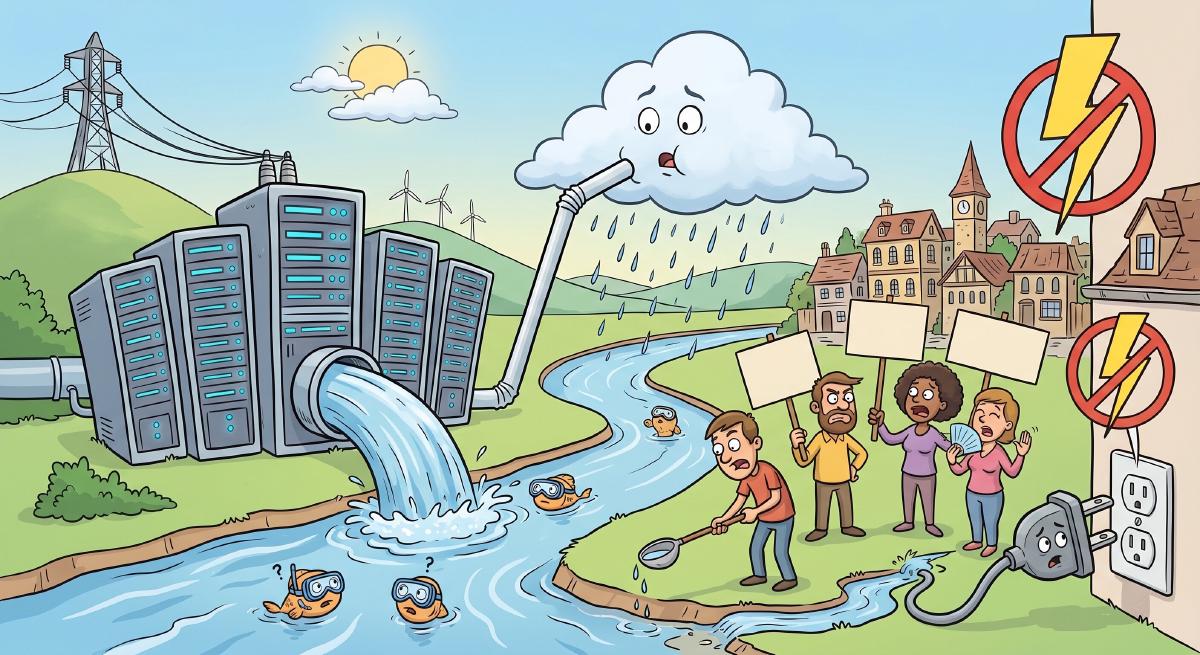

The digital revolution has officially arrived on Main Street, and the local zoning boards are not amused.
For the better part of two decades, the tech industry did an exceptional job marketing “the cloud” as a weightless, invisible, abstract concept. It was a magical digital ether where your photos lived, your code ran, and your enterprise databases scaled flawlessly. But the explosive rise of generative AI has thoroughly shattered that illusion. Training and serving large language models requires massive concentrations of power, physical land, heavy infrastructure, and a staggering amount of water for cooling.
The public has noticed. The cloud is no longer an invisible utility. It is a very large building down the street with a very large appetite.
The Gallup Reality Check#
A landmark Gallup poll released in May 2026 confirmed that public anxiety over this infrastructure boom has officially hit a boiling point. According to the survey, a staggering 71% of Americans oppose the construction of an AI data center in their local community.
To put that number into perspective, consider this jaw-dropping comparison: only 53% of Americans oppose having a nuclear power plant built nearby. ⚛️
Let that sink in for a moment. Statistically speaking, your neighbors would rather live next to a nuclear reactor than a building full of state-of-the-art AI server racks. The cloud has officially bypassed the traditional visual stigma of heavy industry, landing itself squarely at the center of local quality-of-life debates.
Why the Backlash?#
The opposition is not driven by a sudden fear of a sci-fi robot uprising. Instead, it is fueled by practical, down-to-earth math. When local residents pack into county board meetings to protest a new project, they are looking at the inputs and the tradeoffs:
- Water Worries: Traditional data centers rely on evaporative cooling to keep high-performance chips from melting. In drought-prone areas, pumping millions of gallons of water a day to cool servers is an immediate red flag for local farmers and residents.
- Grid Capacity: A single mega-scale AI data center can pull as much power as a small city. Locals are rightfully concerned that adding that kind of massive demand to the local electrical grid could result in higher residential utility bills or decreased grid stability.
- The Employment Disconnect: Data centers are massive construction undertakings, creating thousands of temporary construction jobs. However, once the facility is built, the long-term operational headcount is surprisingly low. Communities are realizing they bear all the local infrastructure burdens while the economic software benefits accrue globally.
From Vibe to Value: Building the Good Neighbor Cloud#
This wall of public sentiment is colliding directly with a massive market expansion. Data center construction pipelines are still operating at historic volumes. So, how does the technology sector move forward?
The answer lies in moving beyond simple public relations and fundamentally changing how these facilities interact with the earth and their host communities. Leading hyperscalers are rewriting their infrastructure playbooks to focus heavily on measurable, localized sustainability metrics.
Instead of draining local resources, modern engineering is pivoting toward a circular, regenerative approach:
- Water-Positive Designs: Cloud innovators are rolling out advanced cooling architectures optimized for heavy AI workloads. These designs use precise temperature control and closed-loop systems that achieve cooling without water evaporation, striving to become completely water-positive.
- Grid Innovation: Instead of merely draining power, modern data centers are entering into massive regional power purchase agreements to bring new renewable energy assets online, effectively greening the entire local grid.
- Community Alignment: Truly integrating into an area means investing in localized workforce development, building regional digital skills pipelines, and creating tangible infrastructure enhancements that directly benefit the families living right down the road.
The era of building hidden tech fortresses is officially over. The future of the cloud relies entirely on creating data centers that do not just compute value for the world, but actively protect and enrich the communities that host them.
References and Deep Dive Material#
To explore the data, the public sentiment trends, and the architectural shifts happening right now, check out these trusted resources:
- The Ground Truth Article: Gallup Survey Finds Local Opposition to Data Centers as U.S. Construction Surges
- Microsoft Sustainability Commitments: Explore the core corporate pillars for carbon, water, waste, and ecosystems at the Microsoft Datacenter Sustainability Hub.
- Microsoft Community Investments: Read real-world stories about building sustainable, connected infrastructure in host regions via the Microsoft Datacenter Community Pledge.
- Advanced Cloud Architectures: Discover how modern facilities are transforming resource efficiency through the Azure Global Infrastructure Experience.